

- Your cart is empty
- Continue Shopping
Lansoprazole vs Omeprazole: Which Is Better for Acid Reflux?
- PHARMACY FIRST
- Posted on
-
by Gulfam
- 0 comments
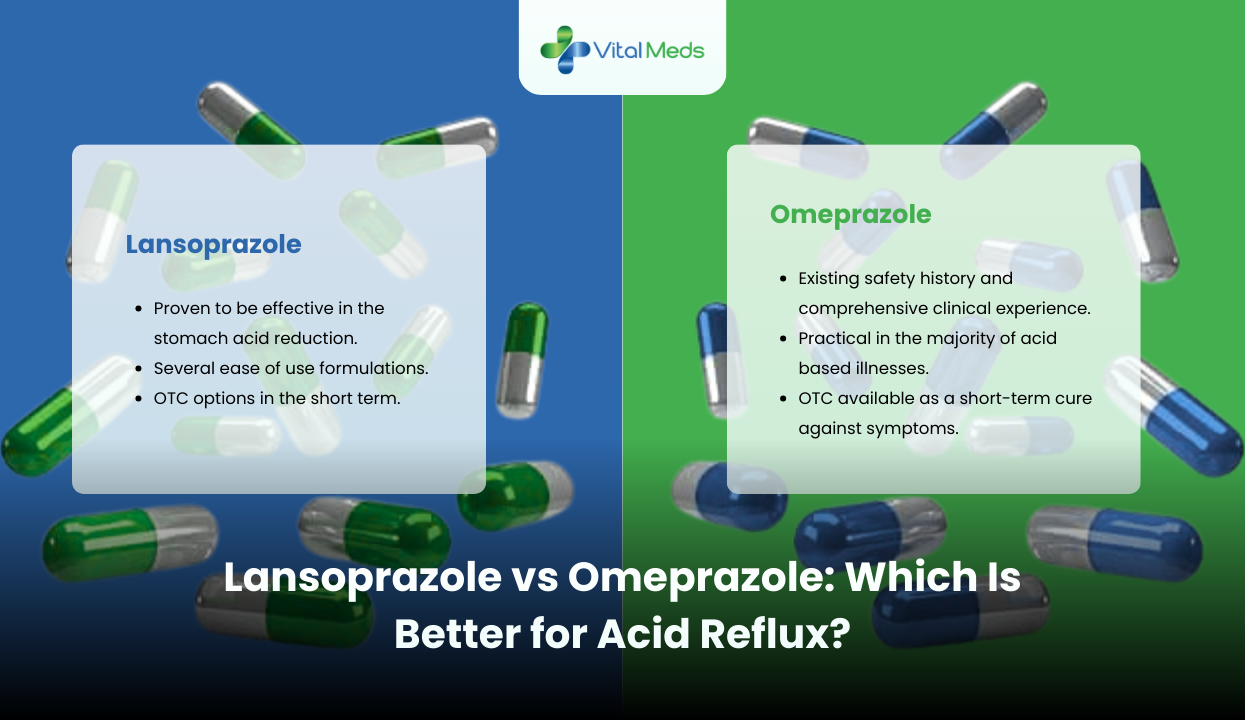
Lansoprazole vs Omeprazole is a Heartburn or acid reflux is a disease that afflicts millions of people globally. It is a disease caused by the backward flow of stomach acid into the esophagus leading to the onset of discomfort, burning and in some instances more severe complications such as GERD (Gastroesophageal Reflux Disease). In order to treat these symptoms, physicians may prescribe Proton Pump Inhibitors (PPIs) – drugs that lower the acid levels produced by the stomach. Two of the most popular PPIs include Lansoprazole and Omeprazole.
The selection of the appropriate PPI may be overwhelming to patients, who have a variety of drugs, different strengths, and over-the-counter. In this article, we shall give a detailed comparison of Lansoprazole vs Omeprazole, the alternatives, how the vitamin B12 may interact with these medications and how you can safely use the over-the-counter PPIs. At the end this understanding will be clear to you to make a well informed decision regarding your treatment of acid reflux.
What Are Proton Pump Inhibitors (PPIs)?
PPIs are a category of drugs, which act by inhibiting the enzyme to produce acid in the stomach. PPIs relieve the symptoms such as heartburn, indigestion, and pain related to ulcers by decreasing stomach acid. PPIs have been found to be more effective than antacids or H2 blockers on the long-term treatment of acid-related disorders.
Common uses of PPIs include:
- GERD and chronic heartburn Treatment.
- Healing peptic ulcers
- Zollinger-Ellison syndrome Prevention of the damage caused by acid.
- Help in elimination of H. pylori infections with the combined use of antibiotics.
PPIs are typically safe when taken as prescribed though they are associated with side effects like headaches, nausea and during long term use they can cause problems with nutrient absorption like vitamin B12 deficiency. This is the reason why it is necessary to know the difference between certain PPIs like Lansoprazole and Omeprazole.
What is Lansoprazole
Lansoprazole is a PPI that suppresses stomach acid and is commonly used in the treatment of such diseases as acid reflux, GERD, and stomach ulcers. Antibiotics are also at times co-administered with it to eliminate H. pylori infections.
The action of lansoprazole begins in 1-3 hours and the effect of the drug persists between 12-24 hours which qualifies it to be used as a daily drug or as a short-term drug. It is available in various different dosages as capsules, orally disintegrating tablets (ODT), and suspensions and hence a versatile alternative to patients who may be unable to swallow tablets.
Pros of Lansoprazole:
- Proven to be effective in the stomach acid reduction.
- Several ease of use formulations.
- OTC options in the short term.
Cons of Lansoprazole:
- The side effects include diarrhea, headaches and nausea among the others.
- Prolonged usage can lessen the absorption of vitamin B12.
- May is incompatible with some drugs.
In general, Lansoprazole is a trusted PPI to use against mild or moderate symptoms of acid reflux and is recommended to the individuals that need flexible dosing.
What is Omeprazole
Omeprazole is a common PPI that is applied in the management of similar conditions as Lansoprazole which include acid reflux, GERD and peptic ulcers. It is also used often together with antibiotics to eliminate H. pylori.
Omeprazole typically takes 1-4 hours to take effect and it lasts 24 hours thus offering consistent symptom control. In most nations, it is sold in capsules, tablets and over-the-counter.
Pros of Omeprazole:
- Existing safety history and comprehensive clinical experience.
- Practical in the majority of acid based illnesses.
- OTC available as a short-term cure against symptoms.
Cons of Omeprazole:
- Side effects: headaches, nausea and stomach pains are possible.
- Vitamin B12 absorption can be impaired by prolonged usage.
- May is incompatible with some drugs.
Omeprazole can be regarded as a bit stronger than Lansoprazole so it would be appropriate in severe cases of GERD.
Lansoprazole vs Omeprazole: Key Differences
Although Lansoprazole and Omeprazole are categorized in the same drug group and they operate in a similar manner, there exist minor differences which can determine the best drug to be used.
| Feature | Lansoprazole | Omeprazole |
| Onset of action | 1–3 hours | 1–4 hours |
| Duration | 12–24 hours | 24 hours |
| Formulations | Capsules, ODT, suspension | Capsules, tablets, OTC |
| OTC Availability | Yes | Yes |
| Side Effects | Headache, nausea, diarrhea | Headache, nausea, abdominal pain |
| B12 Absorption | May reduce with long-term use | May reduce with long-term use |
Effectiveness: The drugs both reduce the stomach acid and manage the symptoms of GERD. It is clinically believed that Omeprazole can be a little stronger in case of severe acid reflux whereas Lansoprazole works in mild to moderate cases. Nevertheless, personal reactions are different, and one should address a medical worker.
Alternative Drugs to Omeprazole
Others might be unable to take Omeprazole because of side effects or interactions. Other possible options in this scenario are:
- Lansoprazole: Equal effectiveness with bendable forms.
- Esomeprazole: A stronger PPI, which is frequently applied in the case of severe GERD.
- Pantoprazole: Reduced drug interactions, good in ulcers.
- Rabeprazole: Another effective PPI that is used in case of reflux and ulcer is rabeprazole.
A doctor should always be able to advise you on the appropriate alternative to make a choice, as it is possible to take into account the medical history, the severity of the symptoms, and other medications.
Omeprazole and Vitamin B12
Omeprazole taken over a long period may also disrupt the absorption of vitamin B12 since one should have acidic stomach contents to release B12 in food. Lack of the vitamin B12 may cause fatigue, weakness, and neurological problems.
How to prevent B12 deficiency:
- Eat foods that contain large amounts of B12 including eggs, dairy, and fortified cereal.
- Use B12 supplements with PPIs in the long-term.
- B12 levels could be checked frequently using blood tests.
This risk should be known to any person on chronic PPI therapy.
Over-the-Counter PPI Options
There are numerous PPIs such as Lansoprazole and Omeprazole that can be taken as an over-the-counter treatment of short-term heartburn. OTC PPIs are easy and must be applied with caution:
- As directed on the label.
- Take not more than the recommended amount.
- Indicate that it should be used not more than 14 days unless a healthcare provider gives a different instruction.
- Consult a doctor in case of persistent symptoms.
These medications are readily available as they are available over the counter, and this would be unsafe without the advice of professionals particularly with chronic conditions.
Choosing the Right PPI
In choosing between Lansoprazole vs Omeprazole, one should take into account:
- Symptom severity: Severe GERD could respond better to Omeprazole.
- Formulation preference: Lansoprazole is available as capsule, ODT, and suspension.
- Medical history: Look at the possible drug interactions and effects of vitamin B12.
- Convenience: They both are OTC, although local availability might be different.
Treatment should be effective and safe by consulting a doctor or pharmacist.
Tips for Safe PPI Use
- Use the drugs 30-60 minutes before meals to avoid the greatest effect.
- Do not take in excess of the recommended doses.
- Talk to your health professional about long-term use.
- Watch out for side effects such as headaches or stomach upsets.
Make sure that there is adequate intake of vitamin B12 in case of chronic therapy.
Conclusion
Lansoprazole vs Omeprazole are both effective drugs in the treatment of acid reflux and GERD. Omeprazole can be used a little bit higher in severe cases and Lansoprazole can be used with flexible dosage and similar efficacy. The choice will be of an individual based on the severity of symptoms, preference of formulation, and medical history. Never start or change PPIs without a medical practitioner.
Compare Lansoprazole and Omeprazole, using alternative medications in case of necessity, pay attention to B12 level, use OTC PPIs in a responsible way to achieve safe and effective treatment of acid reflux.
Frequently Asked Questions
1. What is the main difference between Lansoprazole and Omeprazole?
The two drugs lower the stomach acid, whereas they have differences in terms of initiation, time span and forms. Omeprazole can be a little bit stronger, whereas Lansoprazole has several dosages.
2. Can I take Lansoprazole or Omeprazole over-the-counter?
Yes, they both are over-the-counter remedies to short-term heartburn. Take as directed and call a doctor after 14 days in case of persistence of symptoms.
3. Does Omeprazole affect vitamin B12?
The long term consumption may decrease the B12 absorption which may lead to fatigue and neurological problems. Take B12-containing food or use supplements in case of chronic PPI treatment.
4. Are there alternative drugs to Omeprazole?
Yes, one can use Lansoprazole, Esomeprazole, Pantoprazole, and Rabeprazole. The selection of doctors is determined by tolerance, severity, and interactions.
5. Which is better for acid reflux: Lansoprazole or Omeprazole?
They are both effective, where Omeprazole can be used in severe cases, whereas Lansoprazole can be used in mild and moderate reflux cases. Selection is based on personal requirements and physician instructions.

